Generative AIIn production
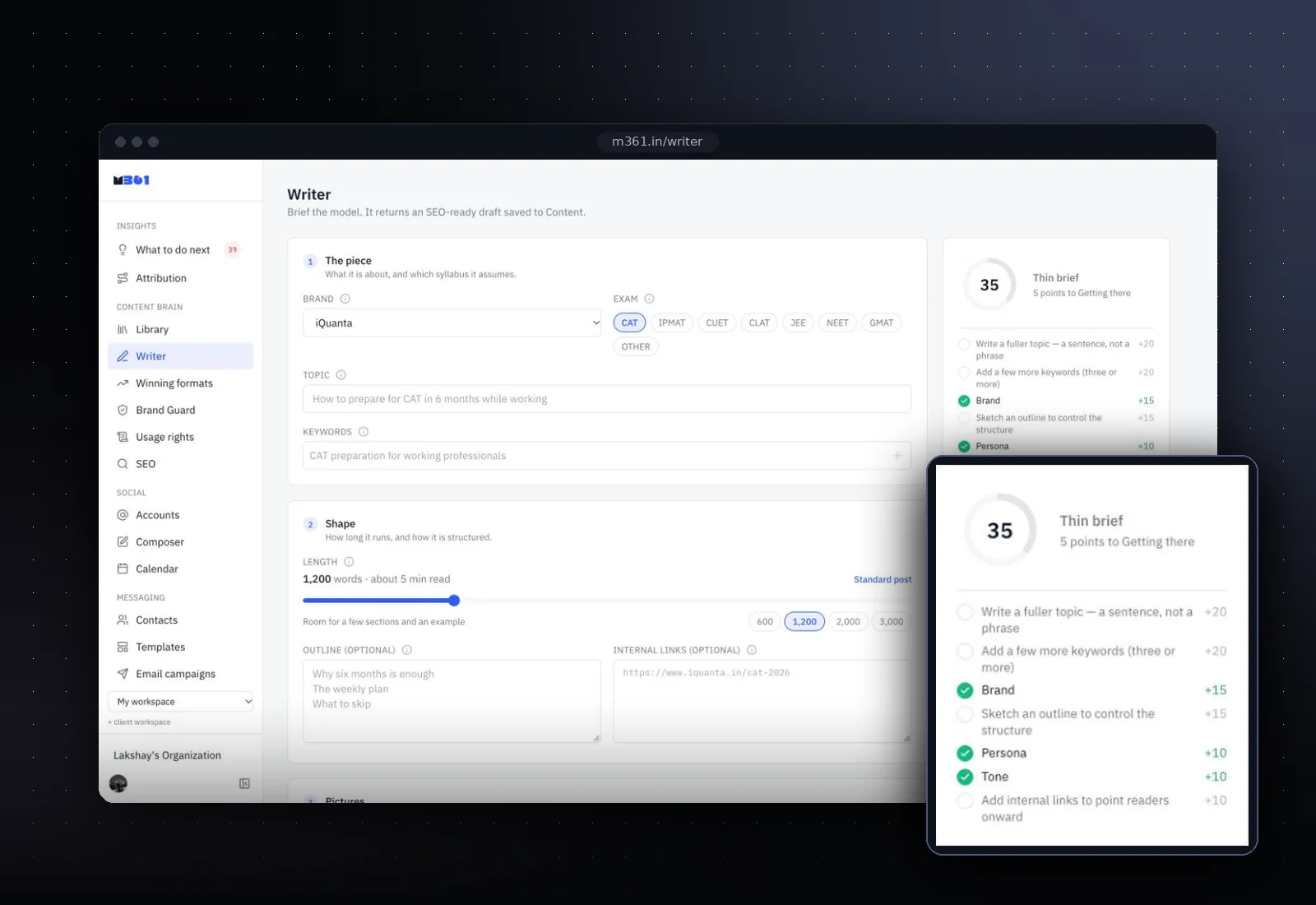
M361 — AI Writing Studio
Brief-to-draft blog engine with brand voice, a live brief-quality score and transparent per-article AI cost.
LLMspgvectorNext.jsPrompt engineering
We build RAG knowledge assistants, copilots and LLM features that answer from your documents and systems, cite their sources and pass an evaluation suite before they reach your users.

Knowledge assistants cite the documents they used, so teams can check every answer.
Accuracy, safety and regression tests run before every release and every model change.
We operate our own AI products in production, including the M361 AI Writing Studio.
Our generative AI development services start with one question: which task gets measurably better with a language model, and how will we know? We run use-case discovery with your team, benchmark prompts and models on real examples, then build the retrieval pipeline, guardrails and interface around what wins. The result is a production system with monitoring and cost controls, not a prototype that only works in a demo.
As a generative AI development company that also builds web and mobile products, we ship the whole feature: the chat or copilot UI, the backend, the integrations and the cloud deployment. You don't need to coordinate an AI vendor, a product agency and an infrastructure team, and nothing gets lost between them.
Retrieval-augmented generation lets a model answer from your content instead of its training data. Our RAG development services cover the parts that decide quality: cleaning and chunking documents, choosing embeddings, hybrid keyword and vector search, re-ranking, permission-aware retrieval so people only see what they're allowed to, and citations on every answer. We build on pgvector, Qdrant, Pinecone or Elasticsearch, depending on scale and where your data must live.
Typical uses include policy and SOP assistants for operations teams, support answer drafting from a help center and ticket history, proposal and report drafting over firm documents, and internal search across CRM notes, wikis and shared drives. Each one gets a test set of real questions with known answers, so retrieval quality is measured rather than assumed.
A copilot works beside a person inside the tool they already use: drafting, summarizing, suggesting the next step and filling in forms. Our AI copilot development services cover in-product copilots for SaaS platforms and internal copilots for sales, support and finance teams. The design matters as much as the model: when the copilot appears, how it shows where an answer came from, and how a user accepts, edits or rejects a suggestion.
We have shipped this pattern in our own products. iSales includes a role-aware AI copilot for admissions teams, and the M361 AI Writing Studio turns a brief into a draft blog post with brand voice, a live brief-quality score and transparent per-article AI cost. Building both taught us to put cost and quality in front of users instead of hiding them.
As an LLM development company, we aren't tied to one provider. We benchmark OpenAI, Claude, Gemini and open-weight models such as Llama, Mistral and Qwen on your task, then choose on accuracy, latency, cost and data rules. Where data can't leave your environment, we deploy open-weight models in your private cloud or on-premises with vLLM or Ollama.
Custom LLM development rarely means training a model from scratch. More often it means better retrieval and structured prompts, and occasionally fine-tuning a smaller model on your examples when it beats a larger general model on cost or consistency. We control running costs with model routing, semantic caching and per-feature budgets, so unit economics hold up as usage grows.
Language models make things up when they lack the right context. We reduce that with grounded retrieval, answers that must cite sources, a clear refusal when the evidence is missing, and structured outputs validated before anything reaches a user or another system. Guardrails screen inputs and outputs for prompt injection, data leakage and off-topic requests, following OWASP guidance for LLM applications.
Every system ships with an evaluation suite: real questions, expected answers and scoring for accuracy, faithfulness to sources and safety. It runs before each release and whenever a prompt, model or data source changes. Tracing and logs show every retrieval and model call in production, so when an answer is wrong you can see why and fix the cause.
Building a generative AI feature is the easy half. Keeping it accurate as your documents change, costs predictable as usage grows and quality steady across model upgrades is the hard half. We build and run our own products in production, and the same senior team that scopes your system builds and operates it. Code, prompts and evals live in your repositories, the system runs in your cloud, and 100% of the IP is yours.
A free 20-minute call, then a short discovery to choose one task and agree how success is measured.
Test prompts, retrieval and models on your real examples before committing to an architecture.
Ship the pipeline, guardrails and UI with weekly demos and an evaluation suite that gates every release.
Monitor quality, cost and latency in production, and retune as your data and the models change.
Brief-to-draft blog engine with brand voice, a live brief-quality score and transparent per-article AI cost.
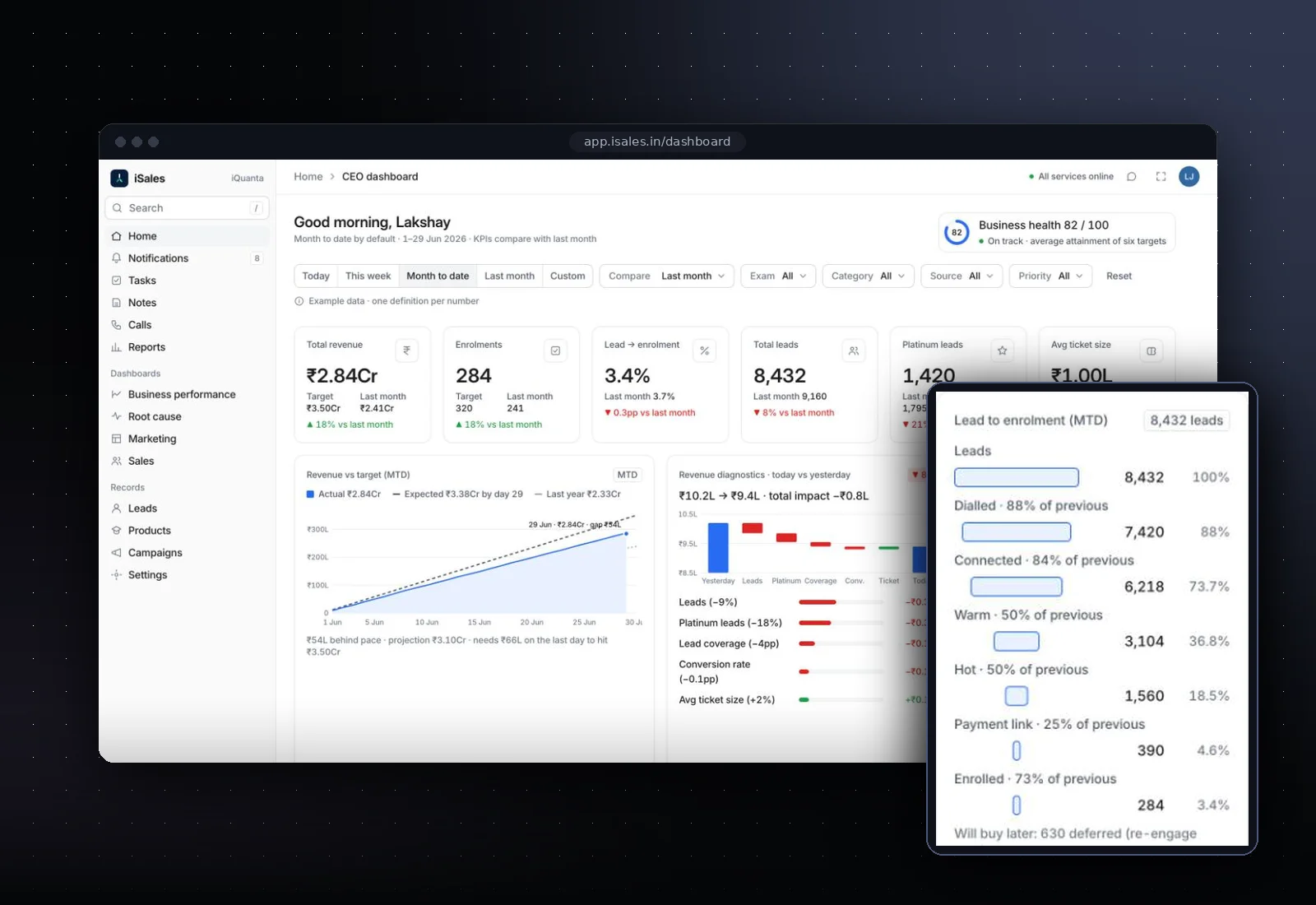
A CRM built for high-volume admissions teams, with role-based dashboards for every seat from counsellor to CEO.
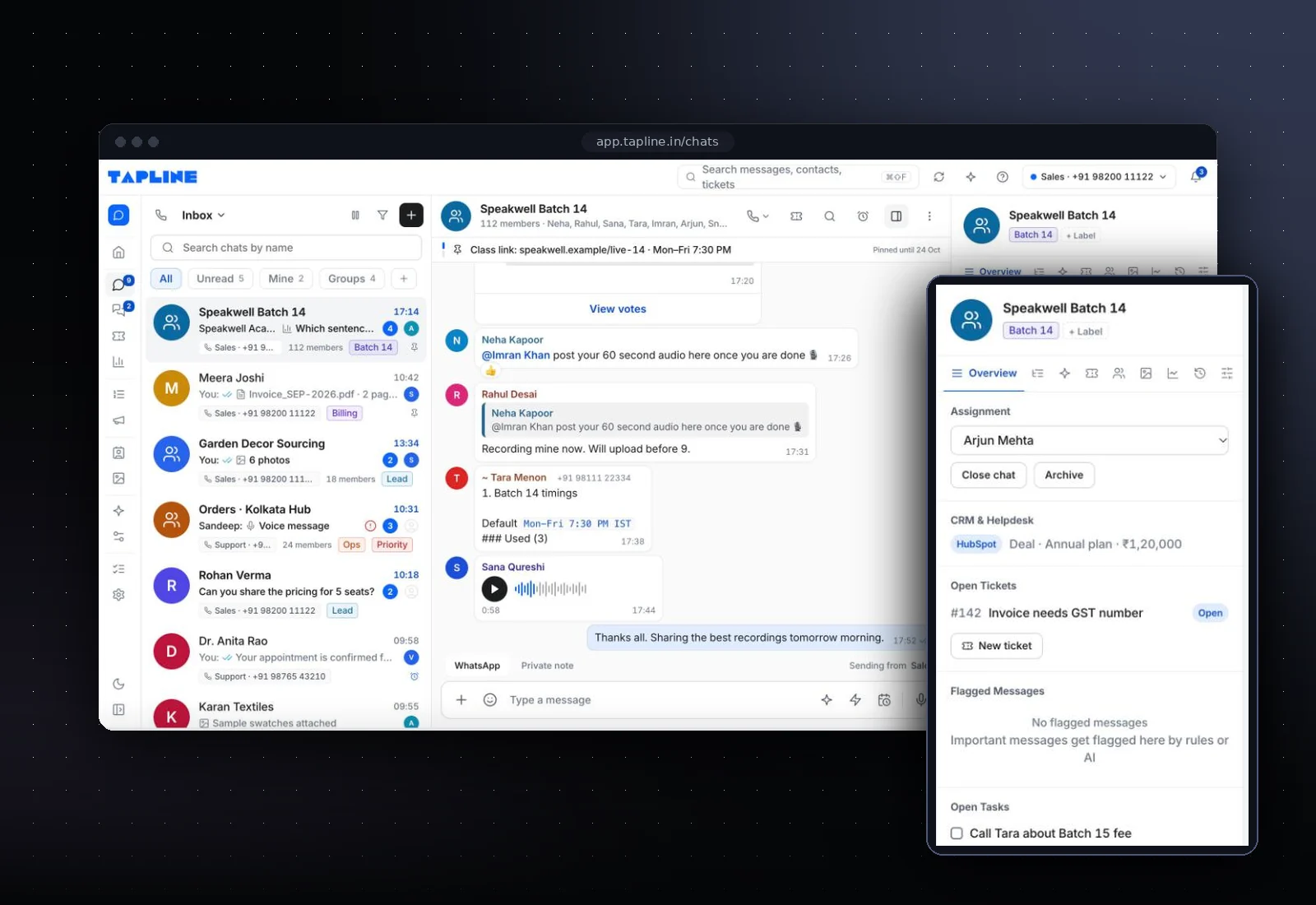
A multi-number WhatsApp inbox where sales and support teams work every conversation with full customer context.

Prove value on one high-impact workflow before you commit further.

Design and ship a complete AI-native product, ready for launch.

A senior team embedded with yours, working in your time zone.
RAG retrieves relevant passages from your content at question time and gives them to the model, so answers stay current and can cite sources. Fine-tuning changes the model's behavior using your examples, which helps with format, tone or narrow tasks but doesn't keep facts up to date. Most knowledge assistants need RAG; fine-tuning is an occasional addition when it lowers cost or improves consistency.
Yes. We deploy in your cloud and region, choose model providers and terms that fit your data rules, and can run open-weight models entirely inside your environment when data can't leave it. Access controls, audit trails and PII handling are designed in from the start, built to support your SOC 2, ISO 27001 or HIPAA audits.
You can't remove it entirely, but you can make it rare and visible. We ground answers in retrieved sources, require citations, make the model say it doesn't know when the evidence is missing, and validate structured outputs. An evaluation suite measures faithfulness before each release, and production tracing shows which source led to a bad answer.
Pricing is fixed per pilot or milestone and agreed before work starts, after a free scoping call. The main drivers are the number and messiness of data sources, permission rules, integrations, the interface required and the evaluation bar. Model and hosting costs are separate and depend on volume; we estimate them up front and design to keep them low.
Yes. We work in your codebase and stack, add the retrieval and model layer as a service your product calls, and design the in-product experience with your team. A copilot inside an existing product is a common starting point for SaaS companies, because it builds on data and users you already have.
It depends on the task, latency, cost and data rules, so we benchmark candidates on your examples rather than defaulting to one provider. We often route between a larger model for hard requests and a smaller one for routine ones, and design the system so you can switch providers later.
Book a free 20-minute scoping call. Bring one use case and a sample of your documents, and we'll outline how we'd build it and measure it.