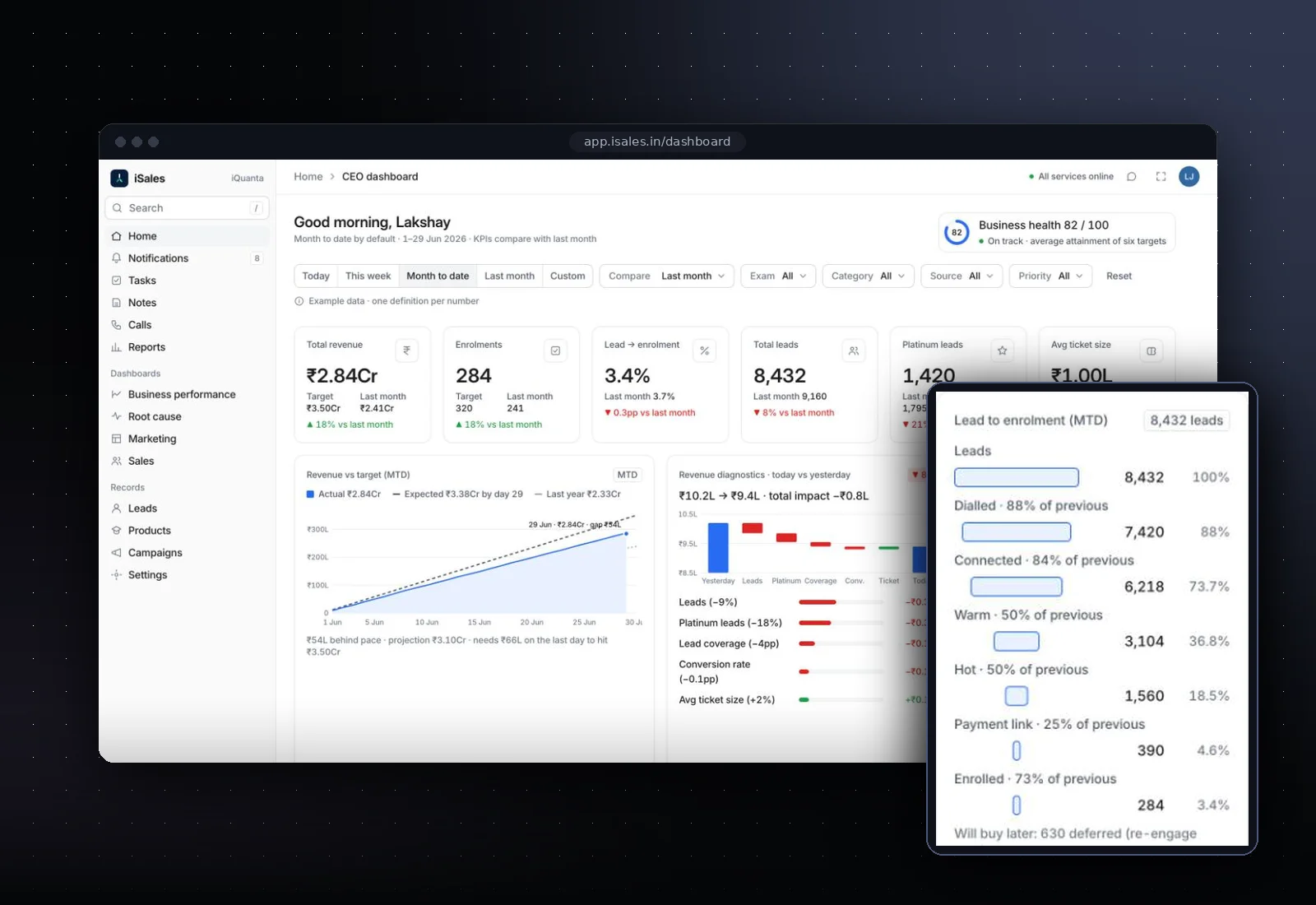
CRM · AnalyticsIn production
iSales — AI-powered sales CRM
A CRM built for high-volume admissions teams, with role-based dashboards for every seat from counsellor to CEO.
Next.jsNestJSPostgreSQLAI copilot
We build custom AI agents for business that plan, use your tools and finish multi-step work in sales, support and operations, with a human approval wherever a decision carries risk.

The engineers who scope your agent build it and run it. No hand-off to a junior bench.
Code lives in your repositories, agents run in your cloud, and 100% of the IP is yours.
Daily overlap with your team's working hours for reviews, decisions and demos.
As an AI agent development company, we build agents that do the work, not demos that describe it. An agent reads the request, decides which steps to take, calls your CRM, inbox, database or internal APIs, checks its own output, and either completes the task or hands it to a person. Our AI agent development services cover the full path: use-case selection, agent architecture and tool design, integrations, evaluation suites, monitoring and a runbook your team can operate.
We start from the workflow, not the model. Most of the effort goes into the tools an agent can call, the data it is allowed to see and the points where a person signs off. Model choice comes after, benchmarked on your real cases across Claude, GPT and open-weight options, and the design lets you switch providers later without a rewrite.
A chatbot answers questions in a conversation. Workflow automation runs a fixed sequence: when this happens, do that. An AI agent sits between the two. It takes a goal, chooses the steps, calls tools and adapts when the input is messy, such as an email with three requests in it or an invoice in an unfamiliar format. Agents take more work to build and test, so they only make sense where the work varies too much for fixed rules.
Plenty of problems don't need an agent. If a rule-based flow in n8n or your existing platform solves it reliably, we will say so on the scoping call. Where custom AI agents for business are the right call, we usually combine approaches: deterministic automation for the predictable steps and an agent only where judgment is needed. That keeps behavior predictable and running costs low.
Our AI workflow automation services focus on work that already has an owner and a measurable outcome. In sales, agents qualify inbound leads, write follow-ups, book meetings and update the CRM after every call. In support, they triage tickets, pull order or account context and draft replies a person can approve in one click. In operations, they extract data from invoices and documents, run approval workflows with human sign-off and flag exceptions before they turn into backlogs.
We build this kind of automation into our own products. iSales, the CRM we built for high-volume admissions teams, runs automated lead allocation and workflows alongside a role-aware AI copilot. That shapes how we design agents for clients: dashboards that show what the agent did, clear ownership when it gets stuck, and results that land in your system of record rather than a side tool.
AI agent development cost depends on a handful of drivers more than on the model. The biggest are the number of systems the agent connects to and how clean their APIs are, how much the inputs vary, how many decisions need human approval, the evaluation bar for accuracy and safety, and where it must run: your cloud, a specific region or on-premises. Ongoing model and infrastructure costs depend on volume, and we design routing and caching to keep them in check.
We don't quote from a rate card. After a free 20-minute scoping call, you get a fixed proposal with deliverables, timeline and cost agreed before any work starts. Most teams begin with a fixed-scope, fixed-price AI pilot on one workflow, then move to a milestone-based product build or a dedicated AI pod on a monthly retainer once the pilot has proved its value.
An agent that can act needs limits on what it can do. We scope each tool to the minimum permissions, require human approval for actions that move money, change key records or contact customers, and trace every step and model call so you can see exactly why the agent did what it did. Agents run in your cloud and region with access controls and audit trails, built to support your SOC 2, ISO 27001 or HIPAA audits.
Before any release, the agent runs against an evaluation suite built from your real cases: accuracy on the task, refusal of out-of-scope requests, behavior on adversarial inputs and regressions against the last version. The same suite runs again whenever a prompt, tool or model changes, so an upgrade is a decision backed by results rather than a guess.
When you hire AI agent developers through AppVerse, you get a senior team based in Gurugram, India, working remotely with companies worldwide and overlapping daily with your working hours. The engineers who scope your agent are the ones who build it and run it after launch. We also build and operate our own products, so we design for month two in production, not just the demo.
A free 20-minute call to walk through the process, systems and constraints. NDA signed before you share anything.
Agree on scope, data access and success measures, then review a fixed proposal with deliverables, cost and timeline.
A working agent on your real data early, with a live demo every week and evals running from the start.
Deploy in your cloud with monitoring, tracing and a runbook. We stay on to run it, or hand over cleanly.
A CRM built for high-volume admissions teams, with role-based dashboards for every seat from counsellor to CEO.
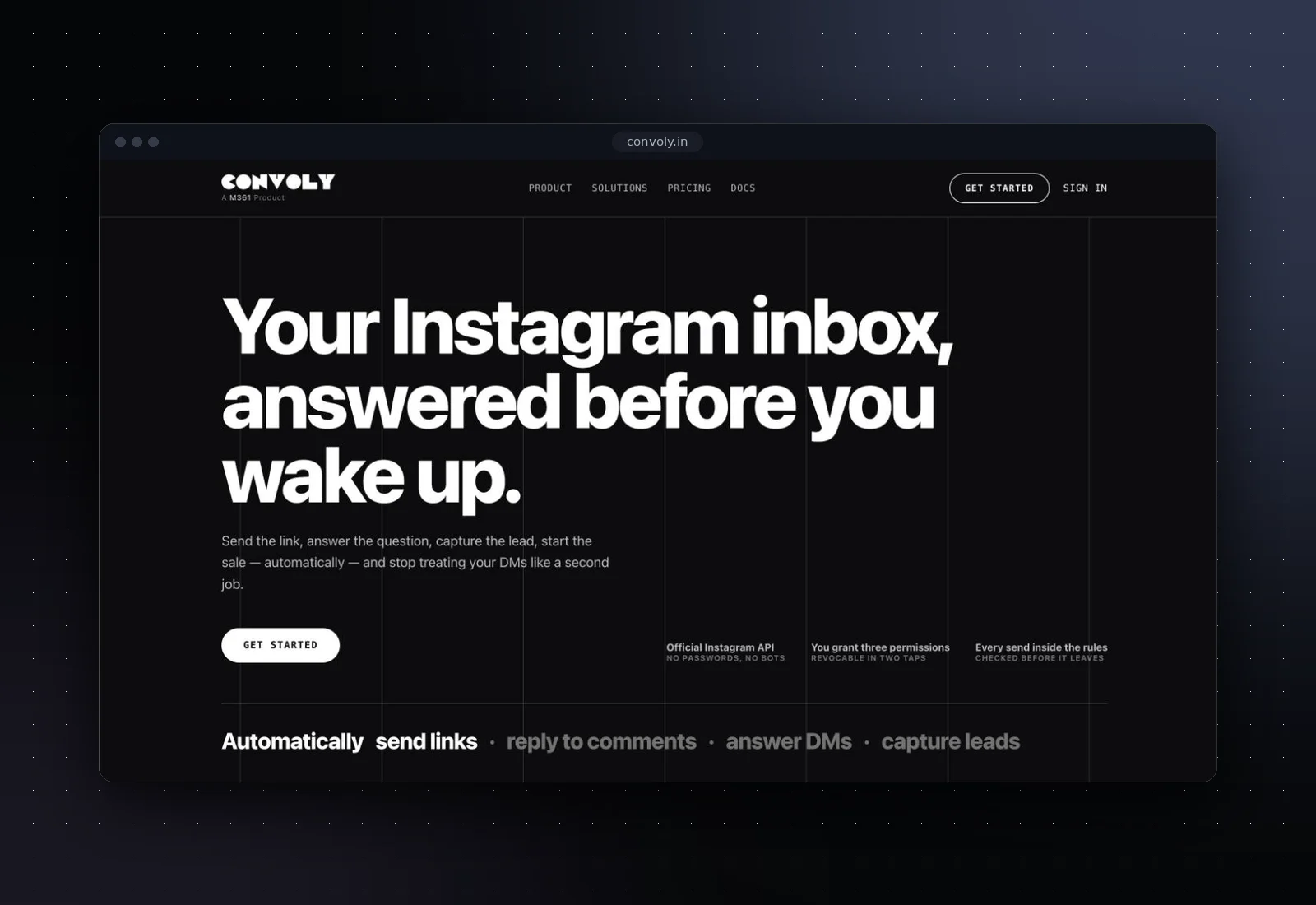
Auto-replies to comments and DMs, sends links and captures leads on the official Instagram API — so brands sell while they sleep.

Prove value on one high-impact workflow before you commit further.

Design and ship a complete AI-native product, ready for launch.

A senior team embedded with yours, working in your time zone.
It depends on scope, integrations and the evaluation bar, so we put a timeline in the fixed proposal rather than quoting a generic estimate. What we can promise is pace you can see: a pilot shows a working agent on your real data early, with a live demo every week until launch, and you can reshape or stop the work at each milestone.
Discovery and agreed success metrics, one agent with its core integrations, deployment in your cloud, and an evaluation report with a roadmap for what to build next. It is fixed scope and fixed price, agreed before work starts, so you learn whether the agent is worth scaling without committing to a full build.
We benchmark candidates on your use case, typically Claude, GPT, Gemini and open-weight models such as Llama or Mistral, and choose on accuracy, latency, cost and data rules. For orchestration we use LangGraph, the Model Context Protocol and the OpenAI and Claude agent SDKs. The design lets you switch providers later without a rewrite.
Yes. Integrating with what you already run is most of the job: CRMs, ERPs, databases, ticketing, email, telephony and messaging. Where a system has a clean API we use it directly; where it doesn't, we use MCP connectors or RPA-style automation, with permissions scoped to what the agent actually needs.
You do. Code, prompts, evaluation suites and configuration live in your repositories, agents run in your cloud account, and 100% of the IP transfers to you. If you later bring the work in-house or move to another partner, you keep everything needed to run and change the system.
You work directly with senior engineers, not an account layer, and the people who scope the agent build and run it. We overlap daily with your working hours for calls, reviews and decisions, and pricing is fixed per pilot or milestone and agreed after scoping, so there are no open-ended hourly bills.
Book a free 20-minute scoping call. We'll tell you whether an agent, a chatbot or plain automation fits, and what a fixed-price pilot would cover.