Generative AIIn production
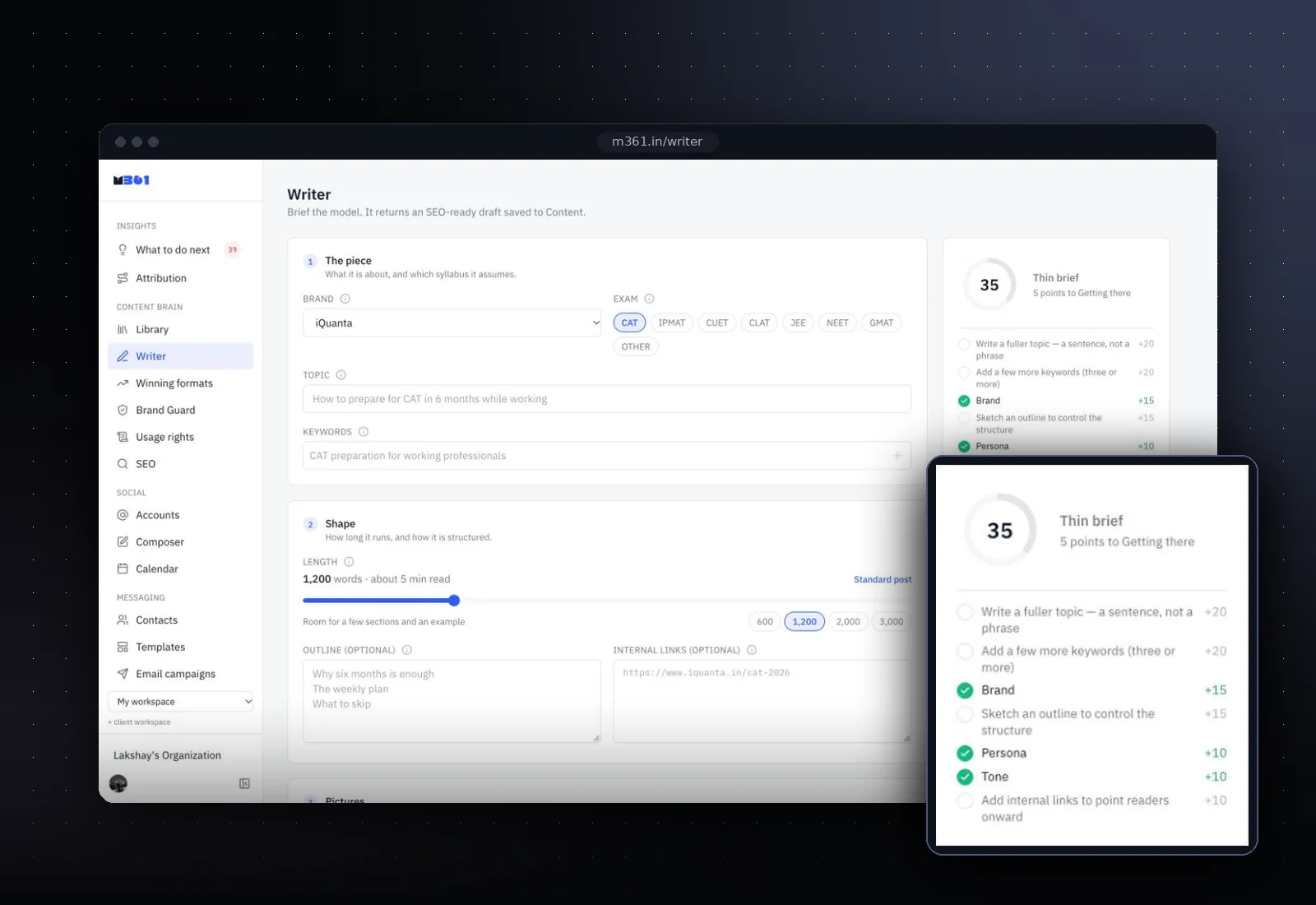
M361 — AI Writing Studio
Brief-to-draft blog engine with brand voice, a live brief-quality score and transparent per-article AI cost.
LLMspgvectorNext.jsPrompt engineering
Prove one high-impact workflow on your real data before you commit further. Fixed scope, fixed price, success metrics agreed up front, and a clear go/no-go report at the end.

A focused scope on the workflow where AI can make a measurable difference.
Scope, cost and timeline agreed in writing before any work starts.
An evaluation report and roadmap that tell you to scale, change course or stop.
An AI pilot covers one workflow, end to end. That might be qualifying inbound leads, triaging support tickets or extracting data from invoices. We start with discovery: how the work happens today, which systems hold the data and where people spend their time. Then we build one agent with its core integrations and deploy it in your cloud, so it runs against your real data, not a demo dataset.
Keeping the scope to one workflow is deliberate. It keeps the price fixed, the timeline tight and the result easy to judge. Anything that comes up outside the agreed scope goes on the roadmap instead of quietly growing the pilot, so you always know what you are paying for.
A generative AI proof of concept tests whether a model can find or produce the right answer from your data. Examples: a knowledge assistant that searches your documents, CRM and wikis and cites its sources; a support assistant that drafts answers from your knowledge base; or a content copilot that writes drafts in your brand voice for your team to edit.
An agentic AI proof of concept tests whether software can finish multi-step work across your tools, with human approval where decisions matter. Examples: a sales agent that qualifies leads and books meetings, an operations agent that processes documents and routes exceptions, or a finance assistant that extracts invoice data and flags mismatches for reconciliation.
Before we build, we agree what success means for your business, in measures you already track or can measure during the pilot. Typical measures include answer accuracy on a test set drawn from your data, time saved per task, the share of cases handled without escalation, response time and cost per task. We set the threshold for each one with you up front, so the result isn't open to interpretation.
At the end you get an evaluation report: how the system performed against each metric, where it failed and why, what running it would cost and what it would take to reach production. It closes with a clear recommendation to go, change course or stop. A no-go is a useful result too: you learn it for the cost of one pilot, not a full build.
If the answer is go, the pilot is not thrown away. It already runs in your cloud on your data, with an evaluation suite you can rerun before every release. Moving to production usually means hardening: more integrations, monitoring and tracing, human-in-the-loop approvals where they matter, cost controls, and handling the edge cases the pilot surfaced.
You can take that work forward as a milestone-based Product Build or a Dedicated AI Pod on a monthly retainer. Either way, the same senior people who scoped and built the pilot carry it into production, and you own 100% of the code and IP throughout. The roadmap from the report becomes the plan for the next phase.
We don't publish a price list, because cost depends on the workflow. The main drivers are the number of systems to integrate, the state of your data, how many languages or channels are involved, and how much evaluation the use case needs. After the scoping call, you get a fixed proposal with deliverables, cost and timeline. Nothing starts until you agree to it.
Once agreed, the price does not move. If we find something mid-pilot that would change the scope, we raise it with you, and you decide whether to add it, swap it for something else or leave it for the roadmap. You see a working system on your real data early, with a live demo every week until the report.
A free 20-minute call on the process, systems and constraints. NDA signed before you share anything.
Within a week, we agree scope, data access and the success metrics that matter to your business.
Deliverables, cost and timeline confirmed in writing before any work starts.
A working system on your real data, deployed in your cloud, demoed live every week.
Results against each metric, running costs, risks and a roadmap to production.
Brief-to-draft blog engine with brand voice, a live brief-quality score and transparent per-article AI cost.
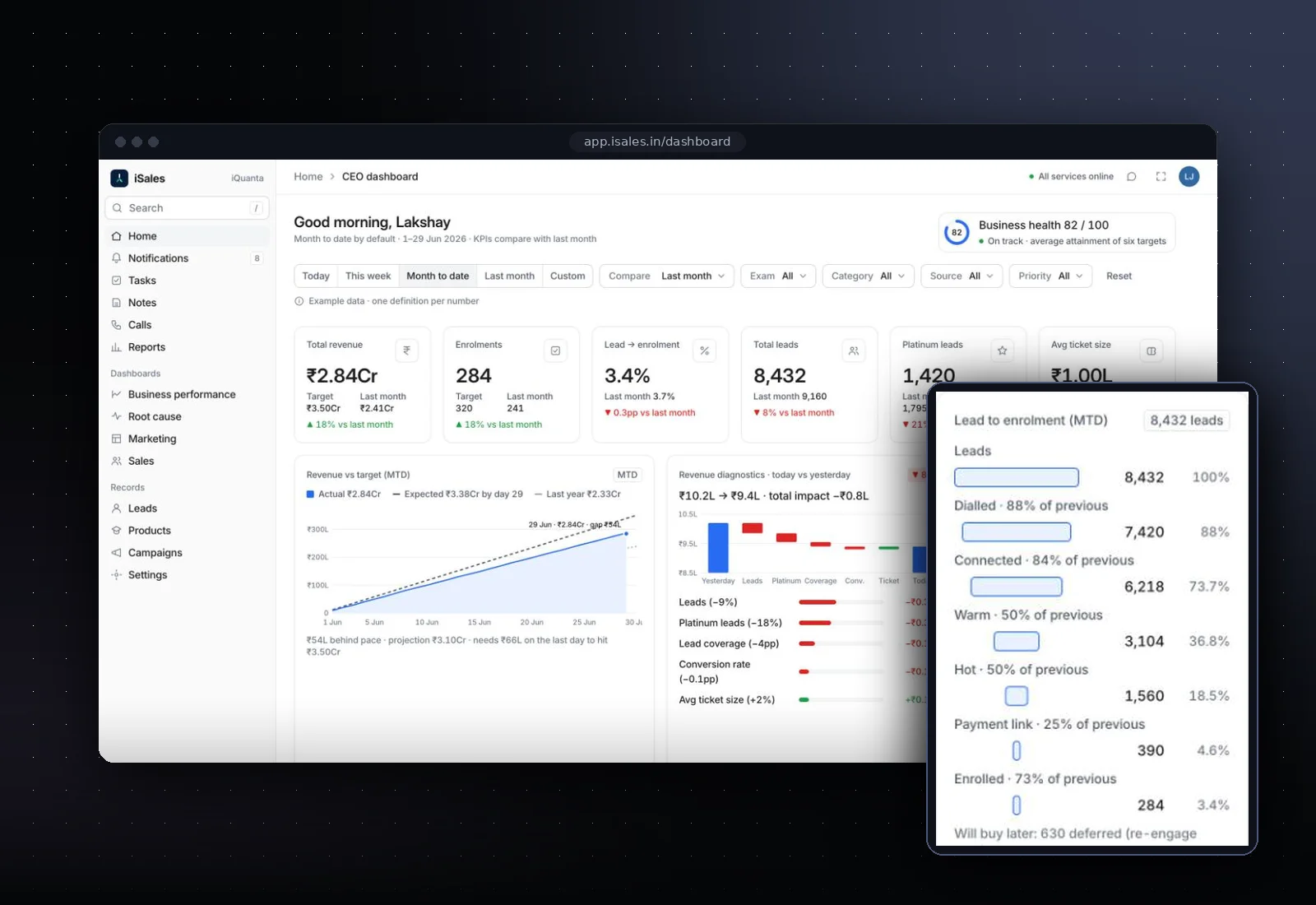
A CRM built for high-volume admissions teams, with role-based dashboards for every seat from counsellor to CEO.
Prove value on one high-impact workflow before you commit further.

Design and ship a complete AI-native product, ready for launch.

A senior team embedded with yours, working in your time zone.
We use the terms for the same thing: a fixed-scope test of one workflow. The difference from a typical demo is that ours runs in your cloud on your real data, with success metrics agreed up front and an evaluation report at the end. You get evidence for a decision, not a prototype that only looked good in a meeting.
It depends on the workflow, the number of integrations, the state of your data and how much evaluation the use case needs. We don't publish prices, but you never start without one: after the free scoping call you get a fixed proposal with cost, deliverables and timeline, and the price stays fixed once you agree to it.
No. Part of discovery is checking what data you have, where it lives and how usable it is. If the data needs work, we say so in the proposal and either include the cleanup in scope or narrow the pilot to data that is ready. It is far better to find data problems during a pilot than halfway through a full build.
It depends on the task, latency, cost and your data rules. We benchmark candidate models on your use case during the pilot and design the system so you can switch providers later. The evaluation report includes the comparison, so the model choice rests on results from your own data rather than our preference.
You stop with a clear answer and a written explanation: where the system fell short, whether a different approach might work and what it would take to try. You still own the code, the evaluation suite and the findings. That is a much cheaper way to learn than discovering the same problem in the middle of a full product build.
It runs in your cloud, in the region you choose, with access controls and audit trails. Code lives in your repositories, and you own 100% of the code and IP. We are based in Gurugram, India, and work remotely with a daily overlap with your working hours, so reviews happen in your day.
Book a free 20-minute scoping call, or WhatsApp +91 74287 20888. You'll get a fixed proposal before any work starts.